

Human trafficking happens everywhere, including here on the Outer Banks. We believe we can better identify and reduce the incidents of human trafficking here if more people understand it and recognize the signs. If you suspect trafficking or believe you are being trafficked, call Hotline’s 24/7 crisis line at (252) 473-3366.
Under the federal Trafficking Victims Protection Act (TVPA), human trafficking includes both sex trafficking and labor trafficking. Labor trafficking occurs when someone uses force, fraud, or coercion to recruit, harbor, transport, provide, or obtain a person for labor or services for the purpose of involuntary servitude, debt bondage, peonage, or slavery. Sex trafficking occurs when a commercial sex act is induced through force, fraud, or coercion, or when the person involved is under the age of 18, regardless of whether force, fraud, or coercion is present.1
Anyone can become a victim of trafficking, regardless of age, race, sex, nationality, or income level. Traffickers often use lies, manipulation, threats, intimidation, isolation, or force to exploit others.
Forced labor is a form of human trafficking. A person may be compelled to work through threats, fear, debt, confiscated identification documents, withheld wages, restricted movement, or dependence on an employer for housing, transportation, or basic needs. What may appear to be a difficult job or unfair working conditions can sometimes be a situation of coercion and control. Learn more.
Trafficking is not always easy to see. Some people are held behind locked doors, but many are hidden in plain sight. They may be working in places we visit every day, unable to ask for help because of fear, threats, language barriers, isolation, or lack of control over their own money, transportation, identification documents, or living situation.
Human trafficking often involves someone a victim knows, including a partner, spouse, friend, neighbor, relative, parent, employer, recruiter, or other person in a position of control. Whether it involves forced labor or commercial sex, trafficking is ultimately about power and control.
Your awareness matters. Knowing the signs can help someone find safety, support, and a way forward.
1. Source: Trafficking Victims Protection Act (TVPA), 22 U.S.C. § 7102. See 22 U.S.C. § 7102 (Definitions)
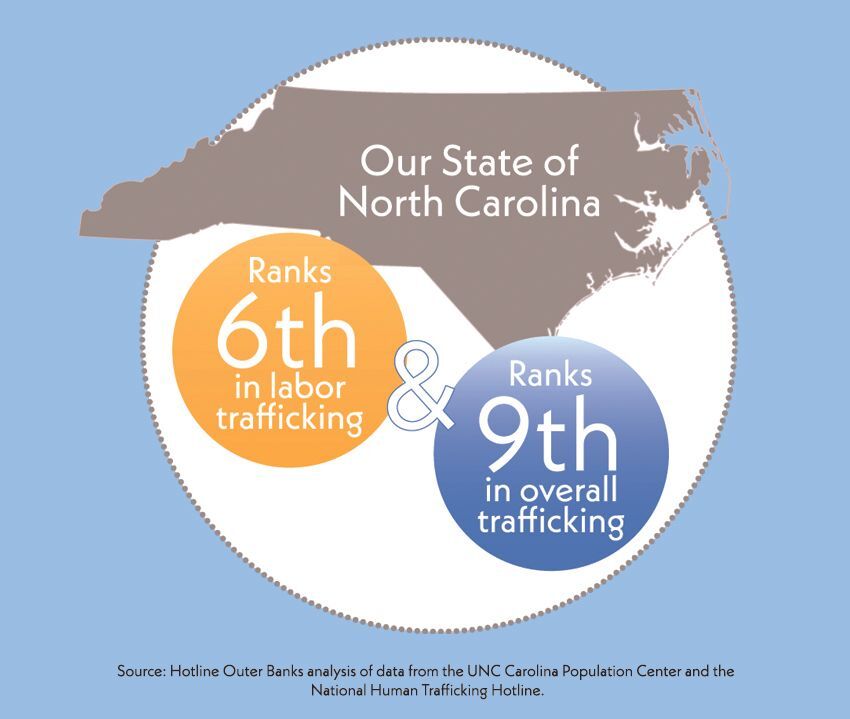
Hotline Outer Banks 24‑Hour Crisis Line
Becoming educated on the myths and signs of human trafficking will significantly impact the ability of traffickers to get away with this crime and help us build a safer and more inclusive community.
The information on this page is part of the human trafficking awareness campaign produced by Hotline Outer Banks under O-OVC-2022-171264, awarded by the U.S. Department of Justice (DOJ), Office of Justice Programs (OJP), Office for Victims of Crime (OVC). The opinions, findings, and conclusions or recommendations expressed in this spot are those of the contributors and do not necessarily represent the official position or policies of the U.S. Department of Justice.